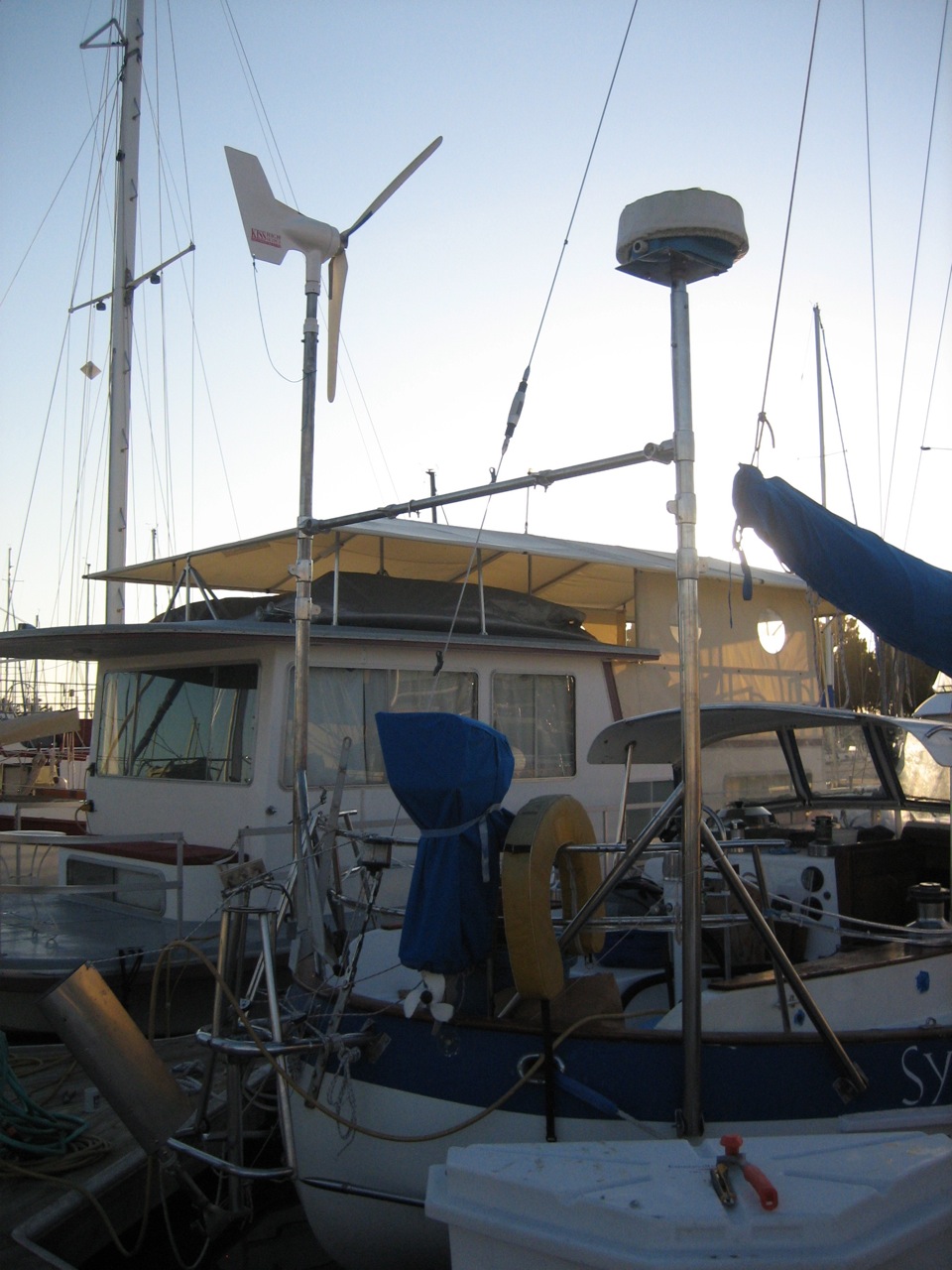
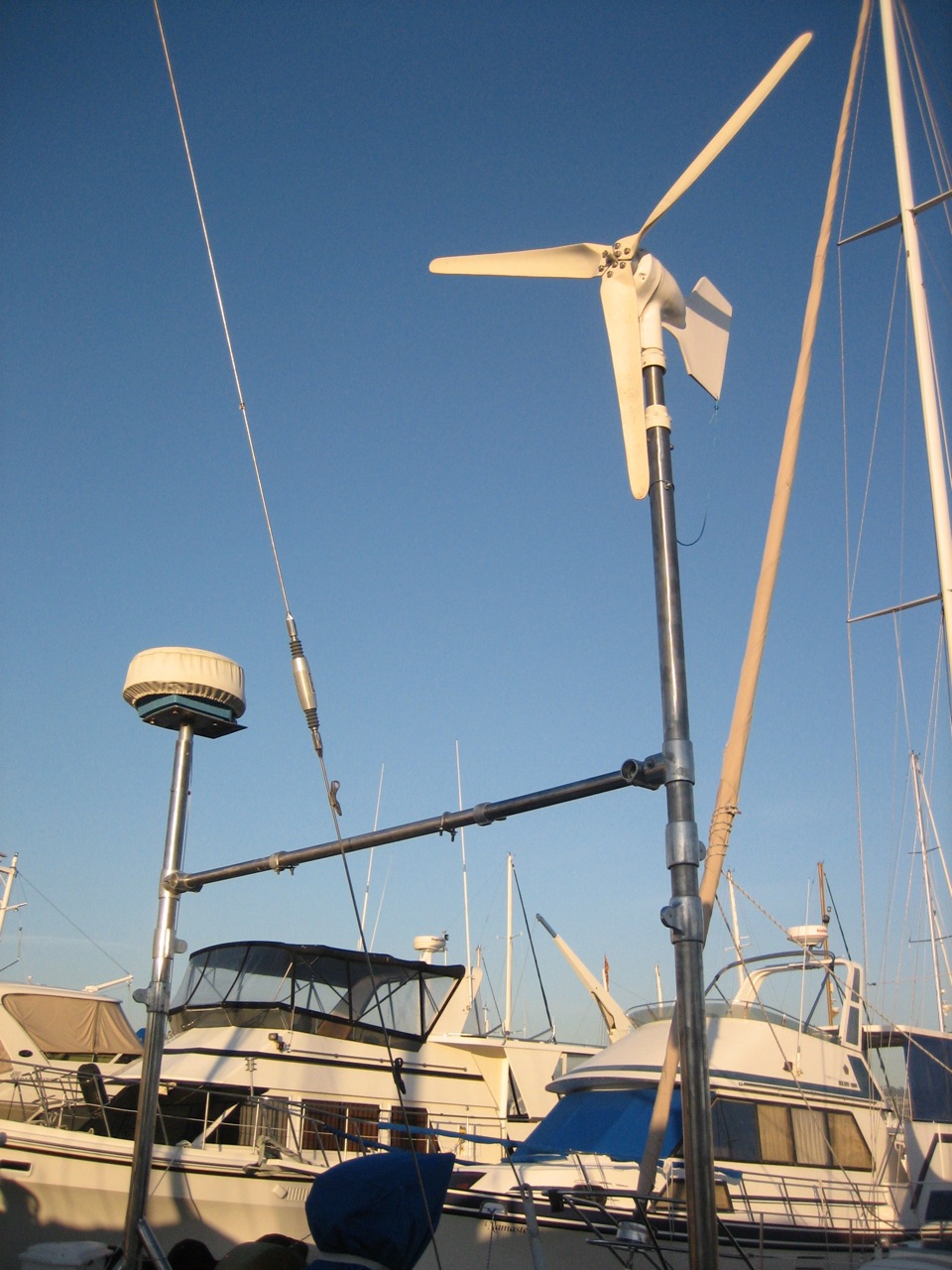
I bid $600 for a three year old KISS wind generator on ebay, never thinking I would win it (the minimum bid was $600), but I did. I was the only bidder; I believe it was because the seller didn’t want to ship it and was located in Pennsylvania (really nice guy though–Mike if you read this don’t worry I’m treating the wind generator to the usage it deserves!). Conveniently, I happened to be driving back east to get married at the right time, so we just stopped off and picked it up. Also conveniently, jonny ended up buying a car right before attending the wedding, so he was able to put it in his car to drive it back to the west coast.
A few notes about the KISS: it is an AC alternator, so the power coming down the three lines out of the generator is three-phase AC. The electrical box that is supplied with it is an on/off switch along with a rectifier. Since the AC is more efficient than the DC, all other things being equal it is better to mount the electrical box closer to the batteries; i.e. use a longer run of cord for the AC and a shorter run after it is rectified to DC.
When the switch is turned to the on position, the generator is under load producing amperage that is fed to the batteries (duh); when the generator is switched to the off position, the generator is shorted out such that it self-brakes. This self-braking works only up to a certain wind-speed.
There are thermal cutouts located in the alternator that will open-circuit the generator if it becomes to hot. When the generator is open-circuited, the alternator can free-wheel and the blades can pick up speed. As soon as the unit cools down enough, it restarts and puts the blades under load again.
So, there are three possibilities: the unit can either be under load and feeding power to the batteries, shorted and braking itself as best as possible, or open-circuited and freewheeling.
If the unit is free-wheeling faster than you are comfortable with (storm conditions), then you have to take a boat hook and use it to push on the tail to rotate the unit out of the wind.
Other models of wind generator have more sophisticated safeguards in them to deal with excessive wind, and even built-in charge controllers to protect the battery from excessive current–I share the opinion of the KISS generator’s inventor, however, that those safeguards are not worth the additional cost and complexity. If you understand how the generator works and how to deal with it in the infrequent situations that it is either producing too much power or speeding out of control, then I see no need to spend the extra money on extra stuff to break.
I would recommend the use of Tef-gel on all the stainless to aluminum surfaces, i.e. the stainless bolts in the aluminum rotor hub, and the aluminum hub on the stainless rotor shaft–it seems to be by far the most lasting protection.
Leave a Reply