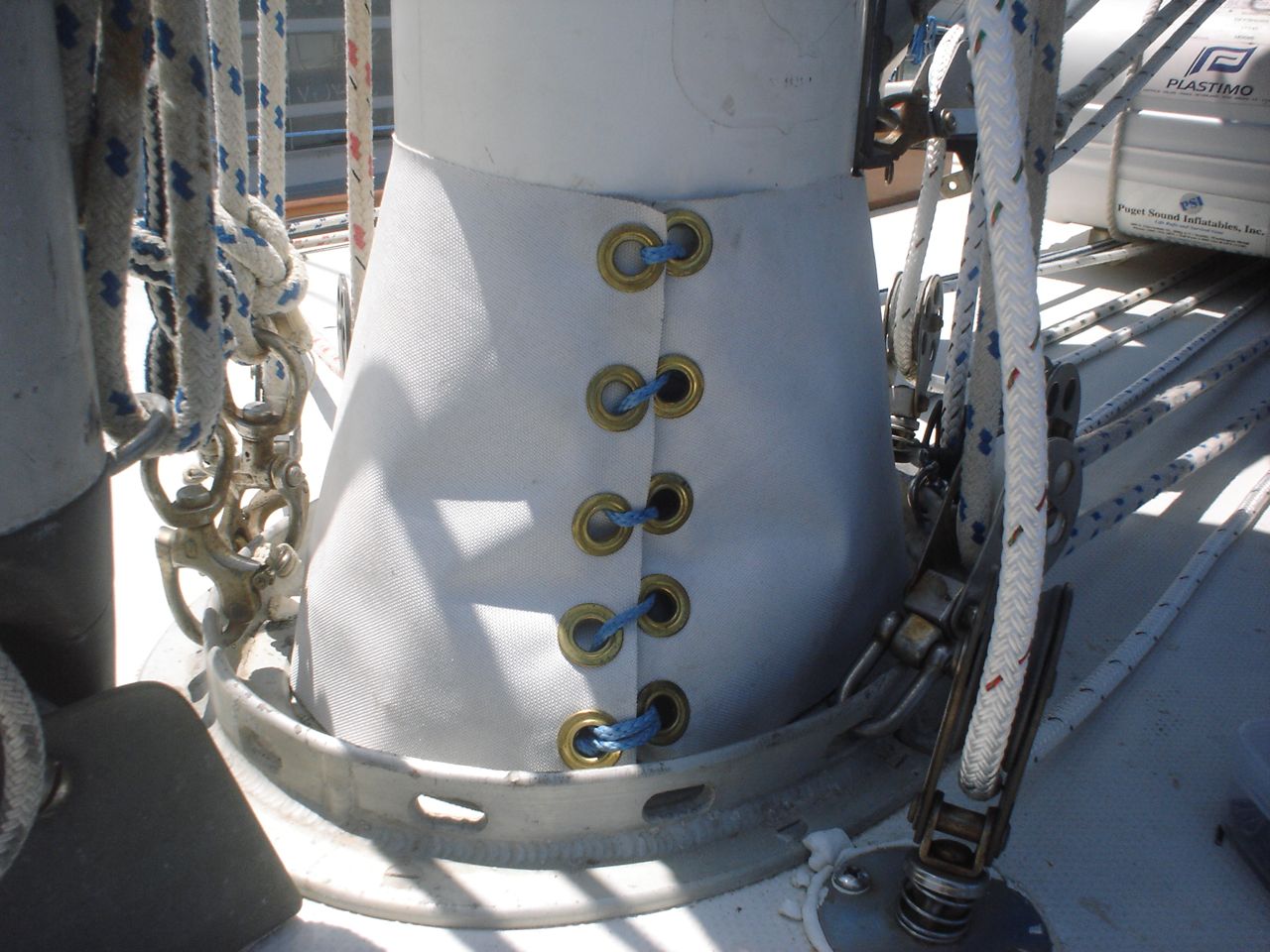
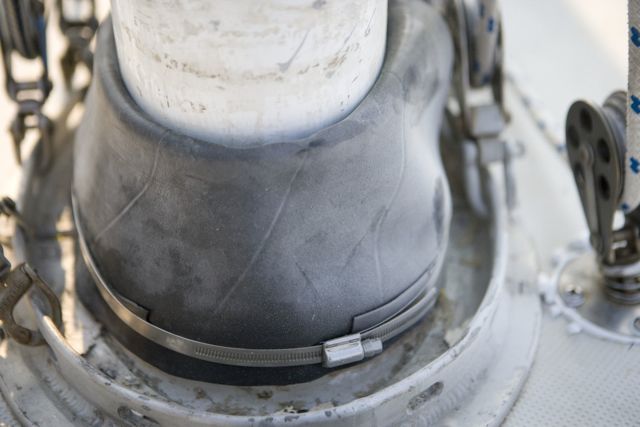
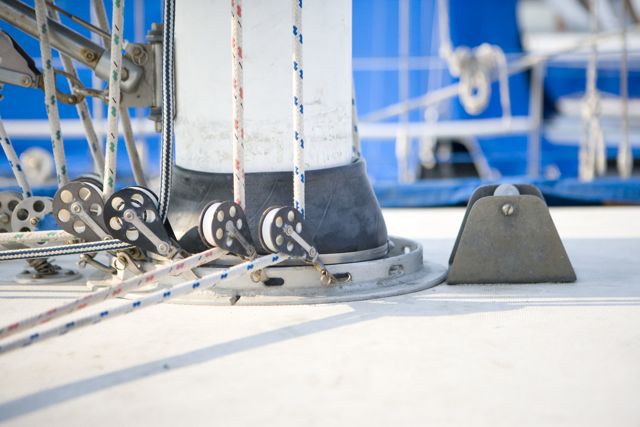
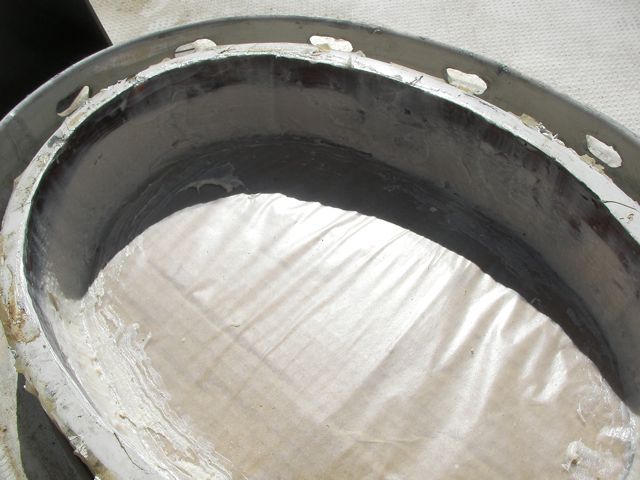
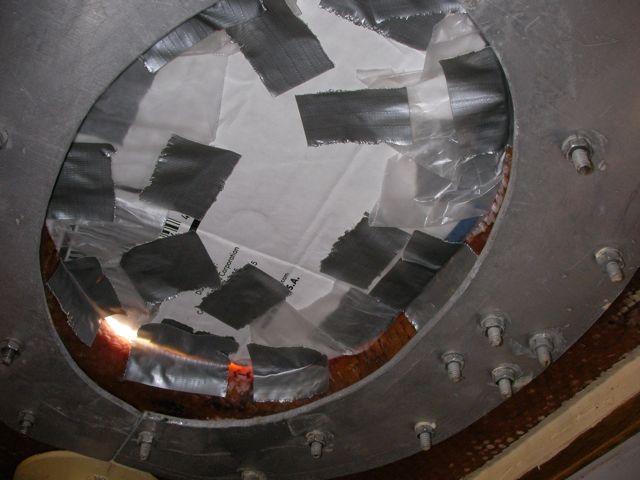
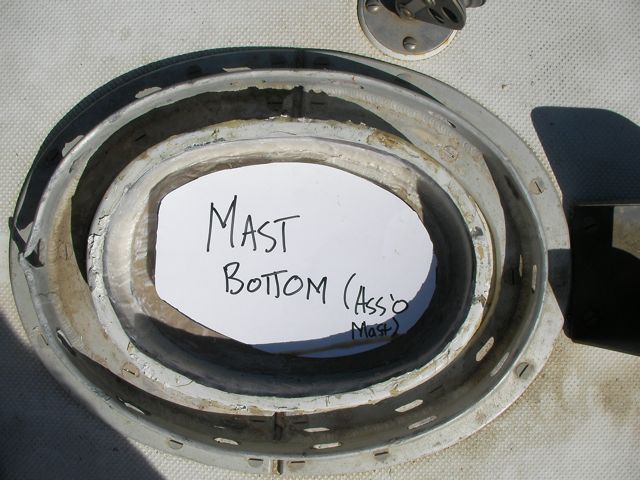
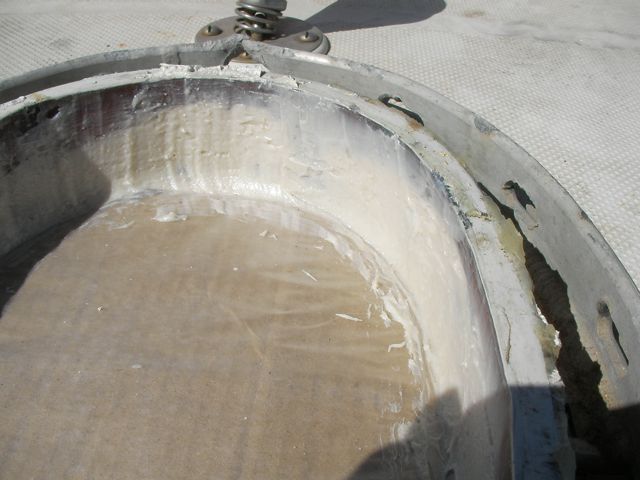
It took us a few weeks after the mast was stepped to finish the job. First we needed to tune the mast in the boat. To start with, the mast was rotated slightly; not aligned with the centerline of the boat. Jon went up to the spreaders with a tape measure and we tried to measure from the spreader tips to the backstay to assess the rotation, but it became clear that the method wasn’t working. So instead Jon went into the bilge and eyeballed the shape of the mast on the step (which is perfectly contoured to the mast base) while I used the disconnected upper shroud to wrench the mast around. It was somewhat disconcerting to be rotating the whole mast without much control. After we got it rotationally aligned, Jon went back up the mast to the top, and we measured from the top to the chainplate on each side, and I painstakingly adjust the uppers (all other shrouds slack) until we got the exact same measurement on each side. So then it was centered at the very bottom of the mast and the very top, but at the deck it was deflected to port by 3/4″. Fortunately, when we pushed on the mast at the deck it readily flexed, so we bowlined a line around the mast, led it through the jib fairlead and back to a winch, and a small amount of force pulled the mast into precise alignment. Then we used a pound of modeling clay, obtained at our local Michaels, to create a floor for the spartite. In truth we didn’t use spartite, but rather the generic McMaster-Carr equivalent (part no: 8644K18) for half the price (on the excellent advice of Bryan Genez). It is a “flexible urethane casting compound”. We used two one-quart containers, $32.33 each, and it was the perfect amount. A momentary digression: the original shape of our mast partners was not conducive to a spartite application so we modified it. The shape of the valiant mast partner is an inverted cone–if the spartite is applied without modifying the partners, the plug will never come out of the boat when the mast is pulled–it will have to be cut out, negating half the benefit of using spartite in the first place. I corrected this by filling in the void area with epoxy thickened with high-density filler (thick like peanut butter), to make the internal surface of the partner vertical and smooth. In retrospect I wish I had even formed it into a slightly upward shaped cone, just to be sure that it will come out easily, but I think it will be ok. Pouring the spartite was fun (mostly because it was easy). We let it set for about 4 days before removing the line that was centering the mast and tightening the other shrouds. Then we constructed a mast boot from a thick tire inner tube. We followed the instructions in one of the books I have, offshore passage-making tips by bill seifert. It involves two large hose clamps and some rubber glue. Cheap, easy, and effective. As a final touch, Jonny made a canvas cover for the rubber boot to protect it from the sun (sorry there’s no picture of this).
Leave a Reply